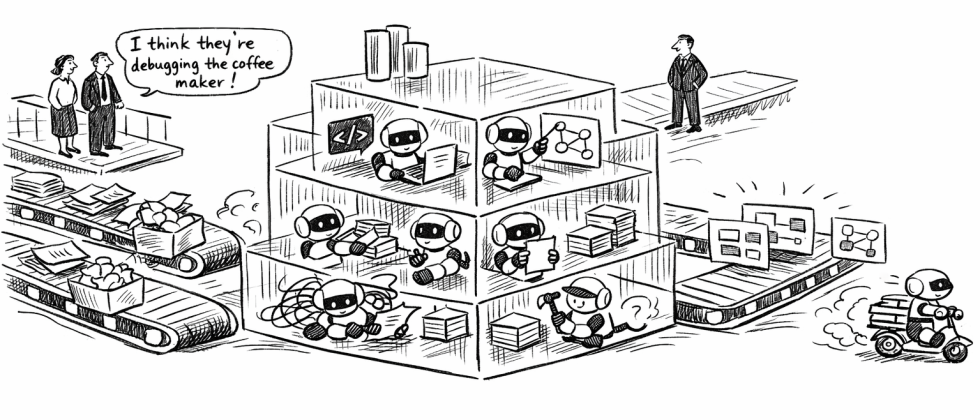
We have recently written a SIGPLAN PL Perspectives article: Repositories Are Human/Agent Knowledge Factories
Here’s a simple example of what that means in practice: The Large File Simplifier 🧩
Imagine you have problems where humans and AI produce code where files are too large, and that this is resulting in bad engineering practices.
You have two choices:
1. You can slow your team down by having them jump more hurdles as they review and merge AI generated code 🛑, or
2. You can maintain team velocity by having an automated agentic process clean things up after the fact 🟢
Of course, you want path (2). But the whole industry is stuck on path (1). Switching to path (2) is the key to velocity ✌️🏆🥇🙌
Agentic repository automation lets you maintain team velocity while eventually converging to clean, simple code that follows your organizational guidelines.
The code simplifier sample is targeted specifically at splitting apart large files in a codebasem addressing your team problem. This workflow produces GitHub Issues, with the agent’s analysis. The human can review, and then assign to cloud agent if they agree.
For example:
- A sample issue was produced by the automation
- It was assigned to Copilot automatically
- This produced a pull request, linked at bottom of issue
Docs, workflow: https://github.com/githubnext/agentics/blob/main/docs/large-file-simplifier.md
The repository is now a factory, with automation agents working hand-in-hand with developers to eventually achieve quality invariants. Everything is under your control, everything operates according to your choices. You, the maintainer, decides how much AI and automation to embrace: None, Some or Lots.
This fundamental lesson applies to every (eventual) good coding practice, every (eventual) performance goal, every directional quality of your repository within reach of automated agentic processing.
Eventual sufficient quality is now the key to software team velocity, and it (or some equivalent) will become a fundamental principle of software engineering. Within that framework you make the choices about what that means:
- What degree of “eventual” you’re happy with
- What “sufficient” means
- What “quality” you care about.

 @dsyme on software